|
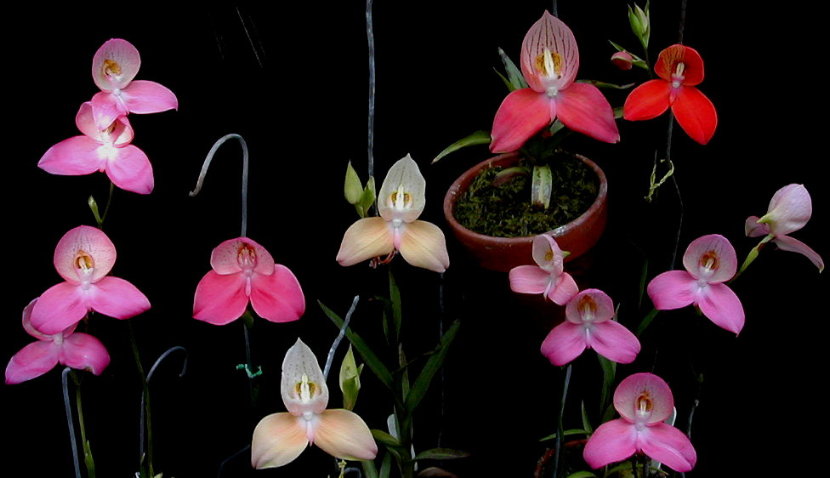
I use the term 'night' to refer to the period of lights-off. In fact, the lights in the growrooms ran during the solar night, being turned off during the solar day. The temperature gain from the HID lights in the growrooms was such that even with venting if they ran during the solar day the growrooms normally hit 95 degrees and above. By inverting the day/night cycle, and as well, venting in some exterior air while venting the lights out through the furnace cold-air return (which heated the entire house at night without the furnace ever firing up!), I could keep the rooms down to the mid-70's during the lights-on period. The temps naturally dropped in the rooms, which were enclosed against exterior walls, when the lights were off, and the large growroom dropped to between 55 and 60 degrees. The disas were in the small growroom for stronger light but the temps there did not drop below 72 or so. The disas weren't getting what they wanted. Then I started putting them in the small growroom for the light and moving them to the large growroom where I sat them on the concrete floor, for their 'nights'. This brought some limited success and two years in a row I had a disa flower during the winter at Christmas. Don't know why I got these off-season blooms, but I was happy just to see them, though they bloomed so far down in the plant the flowers had a hard time opening properly.
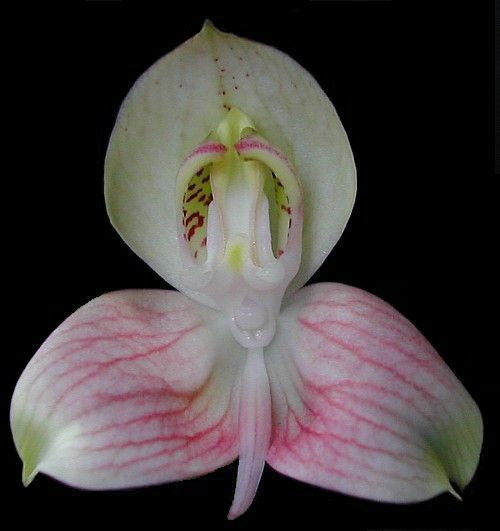
Despite these minor milestones, the summers continued to be rough and alas both of those bloomers expired without making tubers. I was especially distraught over one mostly white Diorosa I thought breathtakingly beautiful when it passed without issue. I continued to acquire new plants mostly in the form of flasks I purchased and an occasional gift of a new plantlet from Jim Harper, a generous fellow member of my local orchid society and noted disa grower and breeder. Of course, as I still got virtually no tuber formation, my small stock of plants completely turned over in a period of a year or two.
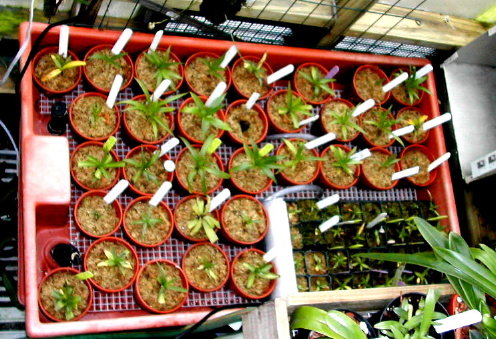
A note about media. My initial medium was a sphagnum/sponge rock mix. I began by growing them sitting in a tray of water frequently refilled. Though this worked well for many folks, it killed most of my first batch of plants and most of my second batch. I stopped growing them sitting in water and moved to keeping them in shallow round trays made by cutting the bottom 4" off a white 5-gallon plastic 'pickle bucket' in which i drilled a 1/4" hole I stoppered with a sharpened pencil. The length of the pencil allowed me to remove and insert it without having to move the plants. A litter box (new) was also pressed into service. A bout of black rot caused me to discontinue this communal watering situation and switch to top-watering.
|